Points clés à retenir
- Les surmatelas ajustent la fermeté, ajoutent du soutien et régulent la température sans remplacer votre matelas.
- La laine surpasse les matériaux synthétiques en termes de confort, de durabilité et de durabilité.
- Les surmatelas en laine naturelle de Woolroom sont hypoallergéniques, sans produits chimiques et entièrement traçables.
- La plupart des surmatelas durent de 3 à 5 ans, mais un surmatelas en laine de qualité de Woolroom dure beaucoup plus longtemps.
- Le bon surmatelas dépend de votre position de sommeil, de votre type de corps et de ce que vous devez changer.
Si vous dormez sur un matelas qui n'est tout simplement pas confortable – trop ferme, pas assez ferme, trop rebondissant, trop enveloppant – ne supposez pas que votre seule option est un remplacement complet. Un surmatelas peut être une solution brillante, pour une fraction du prix d'un nouveau matelas. Il faut un peu de réflexion pour trouver le meilleur surmatelas adapté à vos besoins, et nous sommes là pour vous aider à y voir plus clair.
Qu'est-ce qu'un surmatelas ?
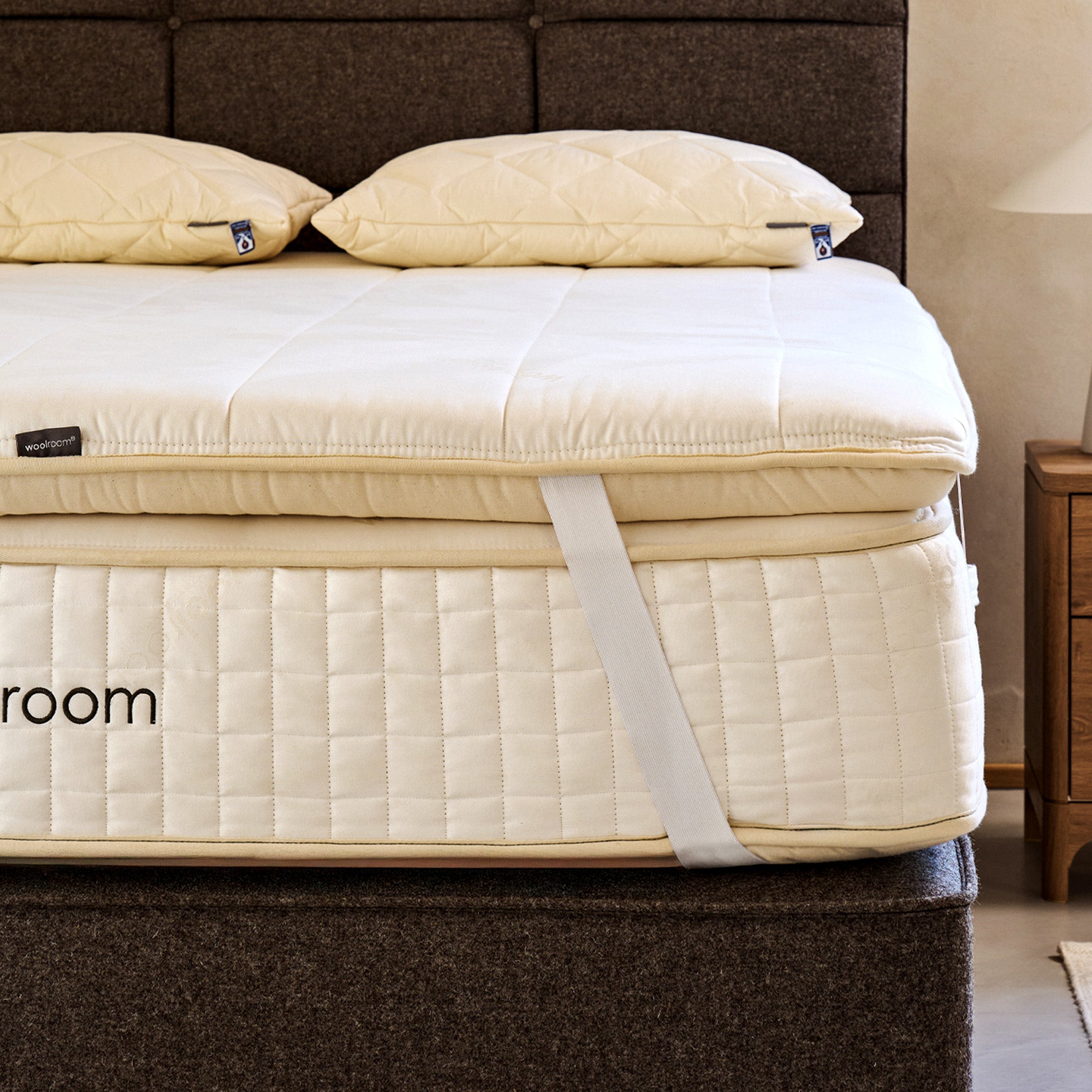
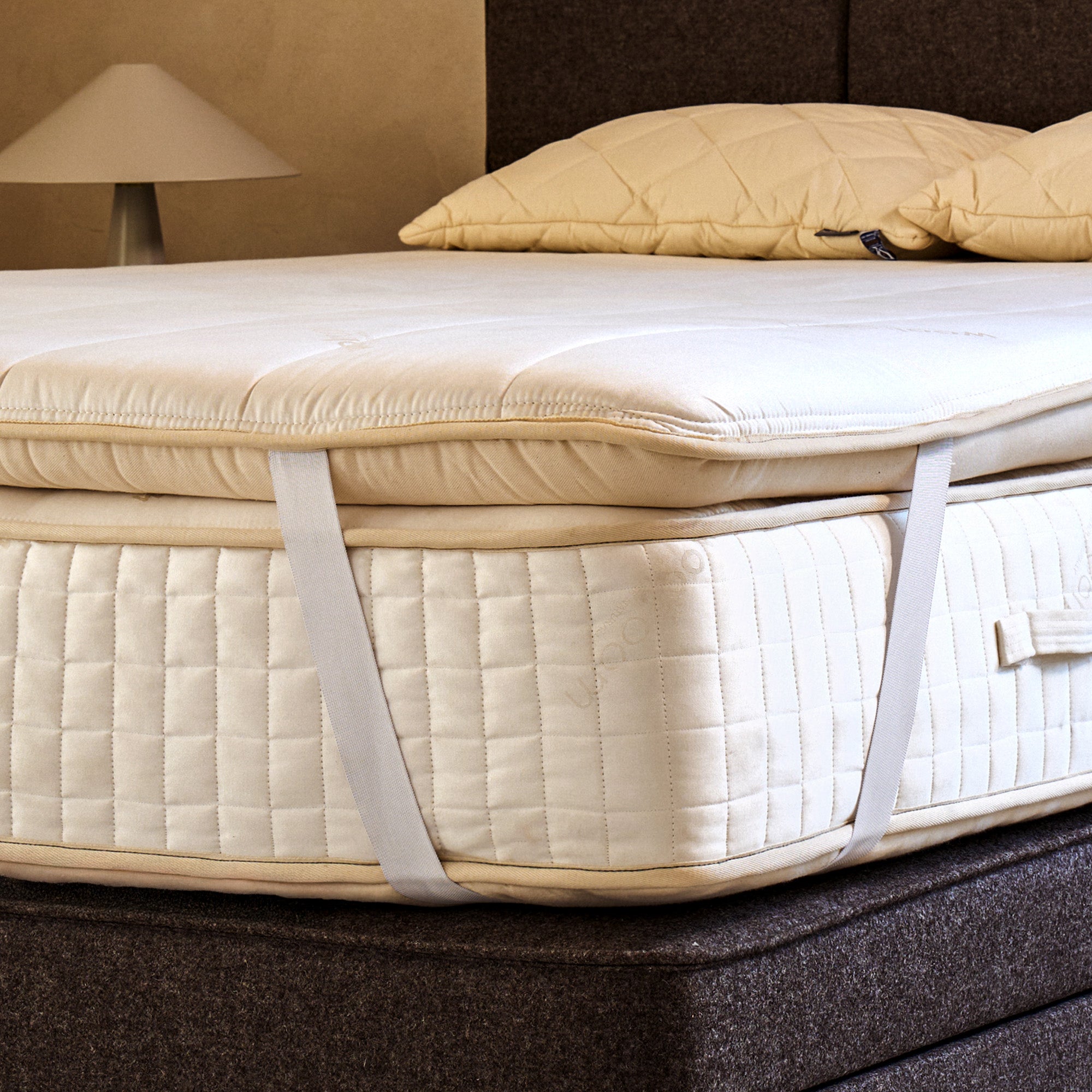
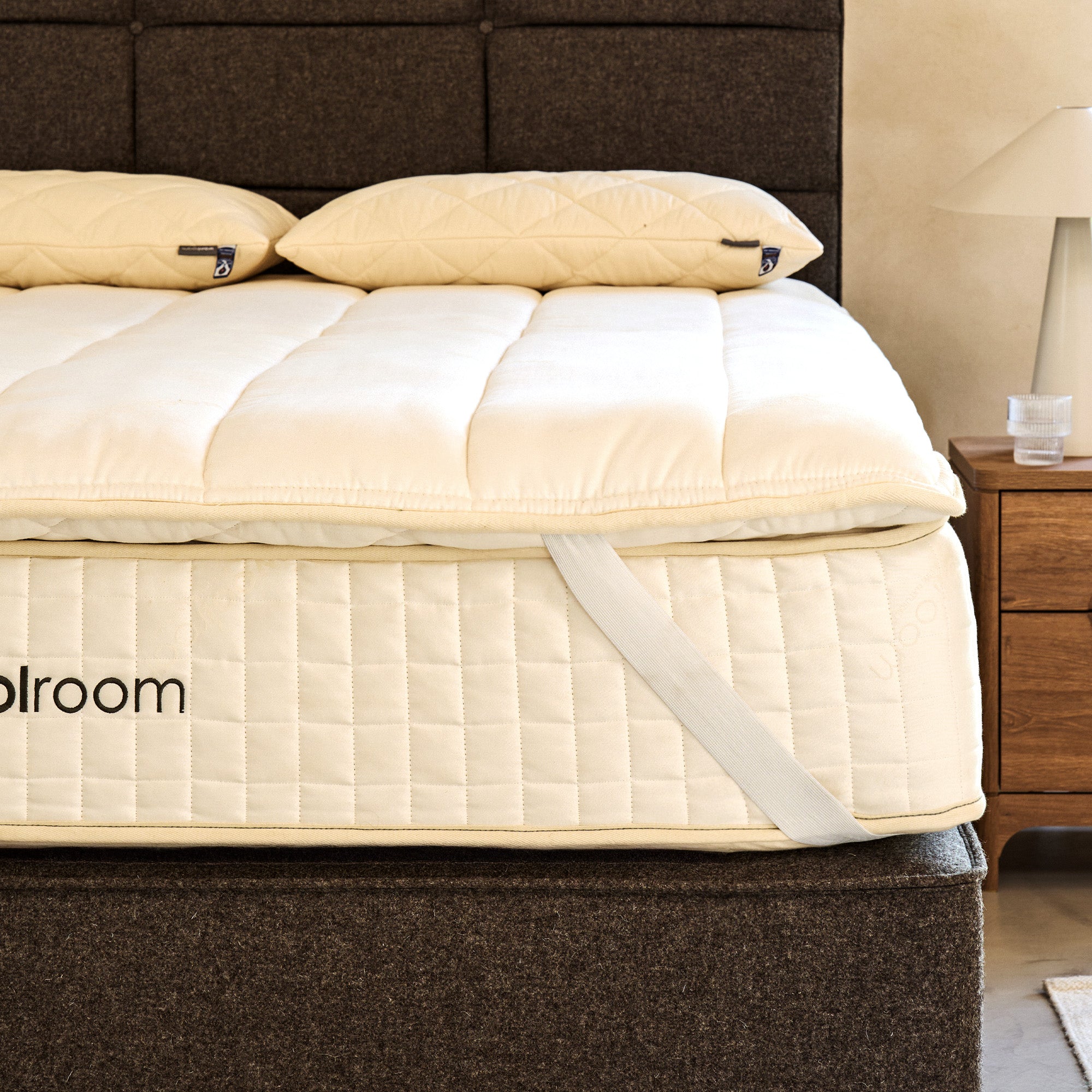
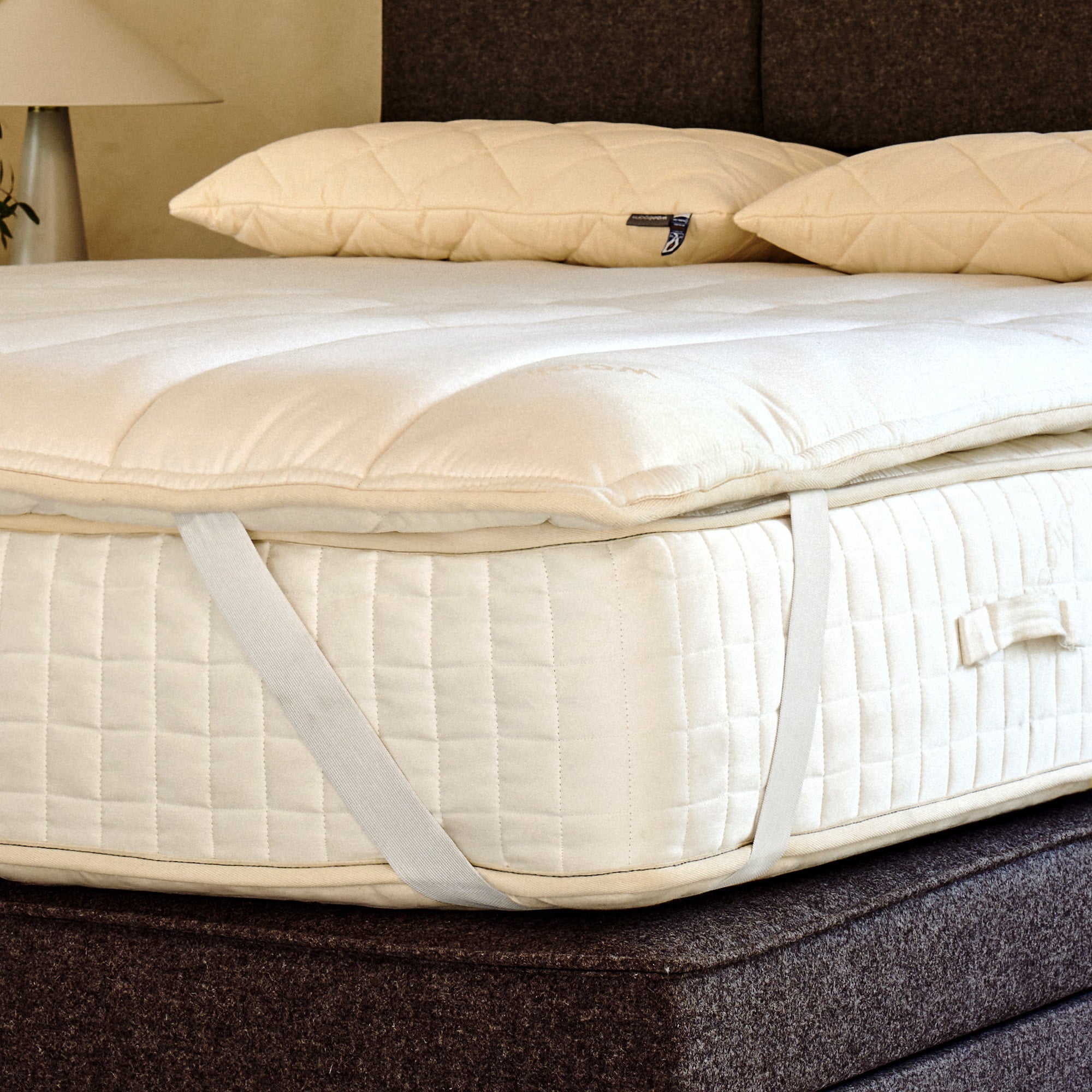
Un surmatelas est exactement ce que son nom indique. C'est une couche séparée de matériau de rembourrage qui se place directement sur le dessus d'un matelas existant pour servir un but spécifique (et, plus souvent, plusieurs choses différentes à la fois). Cela peut être d'améliorer le confort, de modifier la sensation de fermeté ou de douceur du lit, d'ajouter du soutien ou d'apporter une régulation de la température bien nécessaire à votre installation de sommeil.
C'est vraiment ce qui le différencie des autres couches de literie, comme les protège-matelas et les sous-matelas. Un protège-matelas fait exactement cela : c'est une fine couche conçue pour protéger contre l'humidité, les allergènes et les déversements. L'idée n'est pas tant de modifier le confort que de maintenir le matelas frais et propre. Cette couche de literie s'ajuste étroitement sur un matelas, tout comme un drap-housse, et elle peut être retirée et lavée.
Un sous-matelas se situe entre un protège-matelas et un surmatelas. Il est plus épais qu'un protège-matelas et plus fin qu'un surmatelas, ajoutant un niveau subtil de douceur et de protection. Selon sa composition, un sous-matelas peut également offrir une régulation de la température.
À quoi sert un surmatelas ?
Un surmatelas peut être très polyvalent. Selon sa construction et ses matériaux, il offre de multiples avantages :
- Modifier la fermeté de votre lit. Si vous achetez un lit en ligne, déterminer une fermeté appropriée peut être très difficile. La fermeté d'un matelas est subjective, ce qui fait que les évaluations de fermeté des fabricants sont plus une ligne directrice qu'autre chose. Des besoins de santé changeants, comme une grossesse, une condition médicale chronique ou une récupération après une chirurgie, peuvent également rendre une fermeté de matelas différente plus appropriée. C'est là qu'intervient un surmatelas : c'est un moyen facile d'adoucir un matelas trop ferme ou d'ajouter une sensation plus ferme à un lit qui est tout simplement trop mou.
- Ajouter du soutien. Soyons clairs, aucun surmatelas ne peut compenser la différence si votre matelas existant est structurellement compromis. Dans ce scénario, un nouveau matelas est vraiment la meilleure option. Cela dit, un surmatelas avec des micro-ressorts ou une couche dense de latex naturel peut faire une différence significative en termes de soutien ciblé et d'alignement correct sur un matelas trop mou pour maintenir une colonne vertébrale neutre. La répartition uniforme du poids corporel soulage les points sensibles comme les hanches et les épaules, ce qui signifie moins de douleurs le matin.
- Isoler les mouvements. Si vous dormez sur un lit à ressorts avec un partenaire à deux ou quatre pattes, vous savez probablement ce que c'est d'être réveillé à chaque fois qu'il bouge. Un surmatelas fait avec les bons matériaux peut aider à absorber le transfert de mouvement, ce qui signifie des nuits plus paisibles, peu importe ce qui se passe de l'autre côté du lit.
- Réguler la température. La surchauffe est l'une des préoccupations les plus courantes en matière de sommeil, et le bon surmatelas peut aider à soutenir les fluctuations naturelles de la température de votre corps au lieu de les combattre. Cela signifie des nuits plus confortables et un sommeil plus réparateur.
- Prolonger la durée de vie de votre matelas. Avec une couche de soutien entre vous et votre matelas, vous pouvez limiter l'usure normale, les empreintes corporelles et l'affaissement prématuré de votre lit. C'est un excellent moyen de maximiser sa durée de vie. De plus, le bon surmatelas peut réduire les acariens et autres allergènes qui ont tendance à s'accumuler dans les matelas. Cela crée un environnement de sommeil plus hygiénique, ce qui est particulièrement important pour les personnes souffrant d'allergies et de sensibilités.

Avantages du surmatelas
Tout comme les matelas, il existe une multitude d'options de surmatelas. Les avantages individuels sont directement liés à leur construction, à leurs matériaux et à leur qualité générale. Néanmoins, les surmatelas dans leur ensemble présentent des avantages généraux.
- Confort personnalisé. L'ajout d'un surmatelas est un moyen facile de personnaliser votre environnement de sommeil spécifiquement à vos besoins. Vous avez peut-être besoin de mieux gérer la température, d'ajouter un certain soulagement de la pression, ou de créer une barrière entre vous et la mousse à mémoire de forme sur laquelle vous dormez. Tout cela est possible avec le bon surmatelas.
- Économique. Lorsque le choix est de remplacer un matelas ou d'acheter un surmatelas, même le surmatelas le plus cher est l'option la plus abordable.
- Hygiène et protection. Les surmatelas créent une barrière contre la transpiration, les allergènes, les acariens et les cellules mortes de la peau qui s'accumuleraient autrement directement dans votre matelas. De nombreux surmatelas sont également lavables en machine, ce qui rend l'entretien beaucoup plus facile que d'essayer de nettoyer un matelas.
Types de matériaux pour surmatelas
Lorsque vous choisissez un surmatelas, il est important de considérer ce que vous essayez d'accomplir et de remonter à partir de là aux matériaux qui sont à la hauteur de la tâche. Différents matériaux ont leurs propres forces et faiblesses, et il est important de bien faire les choses.
Laine
En tant que fibre pour la literie, la laine est inégalée. Elle coche toutes les cases en matière de respirabilité, de gestion de l'humidité et de régulation de la température, ce qui en fait un véritable matériau de literie toute l'année. Elle est naturellement hypoallergénique et écologique. De plus, lorsqu'elle provient de Woolroom, elle est également d'origine éthique et entièrement traçable.
S'il est vrai que la laine peut être plus chère que d'autres matériaux, elle est aussi incroyablement durable. Cela signifie que sa durée de vie est nettement plus longue que celle d'autres matériaux, en particulier les synthétiques comme la mousse à mémoire de forme et le polyester. Les fibres de laine sont naturellement résilientes et élastiques, ce qui en fait un excellent choix pour les personnes qui souhaitent ajouter de multiples avantages à leur espace de sommeil.
Mousse à mémoire de forme
La mousse à mémoire de forme est un matériau populaire pour les matelas et les surmatelas. Certaines personnes apprécient vraiment la façon dont elle épouse étroitement les courbes du corps – c'est la sensation signature d'être "enveloppé" par ce matériau. Elle répartit bien le poids du corps, ce qui en fait un bon choix pour le soulagement de la pression. Elle peut être attrayante pour les personnes souffrant de douleurs dorsales et articulaires, et elle a tendance à bien fonctionner pour les dormeurs latéraux qui aiment un contour profond.
Pourtant, les inconvénients sont réels. La mousse à mémoire de forme est un matériau à base de pétrole, ce qui est terrible pour l'environnement. Cela signifie également que le matériau dégage des gaz, ce qui peut être un inconvénient si vous avez des sensibilités chimiques ou si vous préférez simplement un environnement de sommeil plus propre et plus naturel. La mousse à mémoire de forme est également réputée pour retenir la chaleur, c'est donc une considération importante si vous avez déjà un sommeil un peu chaud.
Latex
Le latex naturel a beaucoup d'atouts. Il est incroyablement dense et durable, avec une sensation de flottement unique qui donne l'impression de reposer sur le lit plutôt que de s'y enfoncer. Il convient bien aux amateurs d'une sensation plus ferme, plus dense et d'un peu de rebond. Il maintient une température neutre et offre un soulagement de la pression comparable à la mousse à mémoire de forme. Le latex naturel peut également être très écologique lorsque son approvisionnement est clair, bien que l'on ne puisse pas en dire autant du latex synthétique.
En revanche, le latex ajoute un poids significatif, ce qui peut rendre difficile la manipulation d'un surmatelas. Il est également cher et ne convient pas si vous avez une allergie au latex.
Plumes/Duvet
Les surmatelas en plumes ou en duvet sont souvent doux et luxueux, surtout lorsqu'ils sont neufs. Le problème est que ce matériau naturel est assez délicat. Les amas de duvet individuels ont tendance à se compresser après des pressions répétées, ce qui est exactement ce qui se produit lorsque vous vous allongez dessus nuit après nuit. Le duvet est également merveilleusement isolant – un avantage lorsqu'il fait froid, mais un inconvénient sérieux lorsque les températures commencent à augmenter. Il y a aussi des préoccupations concernant le bien-être animal, ce qui rend très important de rechercher des certifications pertinentes, comme Downmark.
Les surmatelas en duvet peuvent également être coûteux, ils conviennent donc mieux aux climats froids et aux personnes à la recherche de luxe qui préfèrent une sensation plus douce.
Alternatives synthétiques au duvet
Ces surmatelas sont une alternative économique au vrai duvet. C'est bon du point de vue du bien-être animal, surtout si vous recherchez une option hypoallergénique. Mais la qualité n'est pas toujours excellente, et même les meilleures options ont une durée de vie plus courte que des matériaux comme le duvet. La compression est également un problème, ce qui rend ces surmatelas plus adaptés à une utilisation occasionnelle uniquement (comme dans une chambre d'amis).
Comment choisir le bon surmatelas
Au-delà du matériau, il y a quelques autres considérations à prendre en compte lors du choix de votre surmatelas. Pensez à ce que vous essayez réellement de résoudre, et laissez cela guider votre décision.
Position de sommeil et morphologie
Votre position de sommeil est l'une des variables les plus importantes. Les dormeurs sur le côté ont tendance à mieux se porter avec un surmatelas plus doux qui amortit les hanches et les épaules – ce sont les points de pression qui subissent le plus d'impact. Les dormeurs sur le dos bénéficient généralement de quelque chose dans la gamme semi-ferme, qui soutient l'alignement de la colonne vertébrale sans laisser le bas du dos s'enfoncer. Les dormeurs sur le ventre ont besoin d'une surface plus ferme pour éviter que les hanches ne s'affaissent et que la colonne vertébrale ne s'arque inconfortablement.
Le poids corporel compte aussi. Les personnes plus lourdes comprimeront la plupart des surmatelas plus rapidement, de sorte qu'un matériau plus dense et plus résilient – comme le latex naturel ou la laine de haute qualité – résistera mieux et offrira un soutien plus constant au fil du temps.
Âge et état du matelas
Un surmatelas fonctionne mieux en complément d'un matelas qui est encore structurellement sain. Si votre matelas s'affaisse de manière significative ou a développé des empreintes corporelles profondes, un surmatelas ne compensera pas entièrement – et vous risquez de vous enfoncer dans le même problème en dessous. Pour un matelas plus récent qui a juste besoin d'être ajusté, cependant, un surmatelas est une solution idéale.
Allergies et sensibilités
Si vous souffrez d'allergies ou de sensibilités chimiques, le choix du matériau devient particulièrement important. La laine naturelle est naturellement hypoallergénique et résistante aux acariens, ce qui en fait une excellente option pour les dormeurs sensibles. Le latex biologique est un autre choix solide. La mousse à mémoire de forme, en revanche, peut dégazer des COV – quelque chose à peser attentivement si vous réagissez aux matériaux synthétiques.
Préférences en matière de durabilité
Pour les acheteurs soucieux de l'environnement, il vaut la peine de regarder au-delà du langage marketing pour les certifications réelles. Des labels comme OEKO-TEX et GOTS offrent une assurance significative qu'un produit répond à des normes environnementales et de sécurité rigoureuses. Les matériaux naturels comme la laine et le latex organique ont généralement une empreinte beaucoup plus légère que les matériaux synthétiques à base de pétrole, et ils durent plus longtemps – ce qui compte aussi du point de vue de la durabilité.
Budget
Un surmatelas est presque toujours le choix le plus économique par rapport au remplacement pur et simple d'un matelas. Cela dit, il convient de considérer le coût par utilisation plutôt que le prix catalogue seul. Un surmatelas en laine ou en latex de haute qualité durera des années plus longtemps que les alternatives synthétiques moins chères, ce qui en fait un meilleur investissement à long terme, même si le coût initial est plus élevé.
Pourquoi les surmatelas en laine naturelle de Woolroom sont meilleurs
Tous les surmatelas ne sont pas égaux – et une fois que vous comprenez ce que les surmatelas en laine naturelle de Woolroom apportent, il est difficile de se contenter de moins.
Régulation de la température
La laine est l'un des rares matériaux qui fonctionne vraiment bien en toute saison. Sa forme naturellement bouclée emprisonne l'air et isole pendant les mois plus froids, tandis que sa respirabilité permet à la chaleur de s'échapper lorsque les températures augmentent. Les surmatelas en laine de Woolroom sont conçus pour soutenir la thermorégulation naturelle de votre corps toute l'année, plutôt que de la contrarier. Et si vos besoins changent radicalement entre les saisons, un surmatelas en laine Woolroom se marie naturellement avec une literie plus légère en été et des couches plus épaisses en hiver, vous offrant une flexibilité totale sans sacrifier le confort.
Gestion de l'humidité
La laine peut absorber jusqu'à 30 % de son propre poids en humidité sans jamais donner l'impression d'être humide. Les surmatelas de Woolroom évacuent discrètement la transpiration nocturne et l'humidité avant même que vous ne vous en rendiez compte, gardant votre surface de sommeil fraîche et confortable tout au long de la nuit. C'est quelque chose qu'aucun matériau synthétique ne peut reproduire aussi naturellement ou efficacement.
Soulagement amélioré de la pression
Les surmatelas en laine Woolroom sont particulièrement efficaces pour répartir uniformément le poids corporel sur la surface de sommeil. Pour les dormeurs sur le côté — qui exercent une pression concentrée sur les hanches et les épaules — ou toute personne souffrant de douleurs articulaires chroniques, cette répartition uniforme peut se traduire par nettement moins de douleurs le matin. C'est un avantage significatif que les surmatelas synthétiques, malgré leurs allégations de soulagement de la pression, ont souvent du mal à offrir de manière constante au fil du temps.
Adapté aux allergies
Les surmatelas Woolroom sont naturellement résistants aux acariens, aux moisissures et au mildiou, trois des déclencheurs les plus courants d'allergies, d'asthme et de peaux sensibles. Contrairement aux alternatives synthétiques qui nécessitent des traitements chimiques pour obtenir des résultats similaires, la laine Woolroom offre un environnement de sommeil plus propre et plus sain par sa nature même. Pour quiconque se réveille congestionné ou inconfortable, cela peut faire une différence notable.
Durabilité
Les fibres de laine de haute qualité sont naturellement élastiques et résilientes, ce qui signifie qu'elles reprennent leur forme nuit après nuit sans perdre leur tenue. Là où les surmatelas synthétiques – la mousse à mémoire de forme en particulier – sont sujets à la compression et à la détérioration au fil du temps, les surmatelas en laine de Woolroom résistent des années, ce qui en fait un investissement à long terme véritablement meilleur.
Durabilité
La laine est biodégradable, renouvelable et a une empreinte environnementale beaucoup plus faible que les matériaux à base de pétrole comme la mousse à mémoire de forme. Chez Woolroom, cet engagement va encore plus loin. Chaque surmatelas est fabriqué avec de la laine britannique entièrement traçable, provenant de sources respectant des normes rigoureuses en matière de bien-être animal et d'environnement – vous savez donc exactement d'où vient votre literie et comment elle a été produite. Pour les acheteurs soucieux de l'environnement, c'est l'un des choix les plus réellement durables du marché.
Sans produits chimiques nocifs
Contrairement à la mousse à mémoire de forme, qui repose sur des retardateurs de flamme synthétiques et est connue pour dégazer des COV, les surmatelas de Woolroom sont entièrement exempts de produits chimiques nocifs. La laine est naturellement ignifuge, ce qui signifie qu'aucun traitement chimique n'est nécessaire pour respecter les normes de sécurité – juste une surface de sommeil plus propre et plus saine dès la première nuit.
Neutralisant les odeurs et naturellement antibactérien
Les propriétés antibactériennes de la laine aident à neutraliser les odeurs à la source plutôt qu'à les masquer, gardant votre espace de sommeil plus frais plus longtemps. Les surmatelas de Woolroom sont également faciles à retirer et à entretenir, ce qui simplifie l'entretien d'une manière que le nettoyage d'un matelas ne permet tout simplement pas.
Construire un système de sommeil naturel complet
Un surmatelas en laine Woolroom est un excellent point de départ – mais il fonctionne encore mieux dans le cadre d'une installation de sommeil naturelle complète. En superposant votre surmatelas avec les couettes, oreillers et protège-matelas en laine de Woolroom, vous créez un environnement de sommeil entièrement cohérent où chaque élément travaille de concert pour vous garder confortable, soutenu et bien endormi.

Quand acheter ou remplacer un surmatelas
Vous ne savez pas si vous avez réellement besoin d'un surmatelas ou s'il est temps de remplacer celui que vous avez ? Le signal le plus courant est simple : vous ne dormez pas bien, et votre matelas en est probablement la cause. Si votre lit est trop ferme, vous réveille avec des douleurs articulaires ou dorsales, ou est inconfortablement chaud pendant la nuit, un surmatelas est souvent la solution la plus pratique et la plus rentable. Il est également judicieux d'envisager un surmatelas si votre matelas s'est légèrement affaissé ou a perdu une partie de son soutien d'origine – pas assez pour justifier un remplacement complet, mais suffisamment pour affecter la qualité de votre sommeil. Un surmatelas plus ferme et plus dense peut combler cet écart et offrir à votre matelas une durée de vie supplémentaire significative.
À quelle fréquence remplacer un surmatelas
La durée de vie varie considérablement selon le matériau. Les surmatelas en laine – en particulier ceux de haute qualité comme ceux de Woolroom – durent généralement entre 5 et 10 ans avec un entretien approprié, surpassant largement les alternatives synthétiques. Les surmatelas en mousse et en polyester, en revanche, doivent généralement être remplacés tous les 2 à 4 ans, car la compression et la détérioration s'installent relativement rapidement avec une utilisation régulière. Si votre surmatelas a perdu sa forme, développé des empreintes permanentes ou ne procure plus le confort qu'il offrait auparavant, il est temps de le remplacer.
Conseils d'entretien et de maintenance
Tirer le meilleur parti de votre surmatelas se résume à quelques habitudes simples. L'aérer régulièrement, surtout avec un matériau naturel comme la laine, aide à maintenir la fraîcheur et empêche l'accumulation d'humidité au fil du temps. Associer votre surmatelas à un protège-matelas respirant ajoute une couche de défense supplémentaire contre les déversements, les allergènes et l'usure générale, prolongeant considérablement sa durée de vie. Lorsque vous devez le nettoyer, nettoyez les taches si possible et suivez toujours attentivement les instructions d'entretien du fabricant, en particulier avec la laine, car un lavage incorrect peut affecter les propriétés naturelles de la fibre.
L'essentiel sur les surmatelas
Un surmatelas est l'un des moyens les plus simples et les plus abordables d'améliorer considérablement votre sommeil, sans le coût ni l'engagement de remplacer entièrement votre matelas. Que vous cherchiez à ajuster la fermeté, à soulager les points de pression, à dormir plus frais ou simplement à prolonger la durée de vie d'un lit que vous aimez déjà, le bon surmatelas peut faire une réelle différence. N'oubliez pas que le matériau est plus important que tout le reste – et que la laine naturelle surpasse les alternatives synthétiques sur presque tous les plans. Les surmatelas Woolroom combinent tout cela avec de la laine britannique entièrement traçable et les normes de qualité qui l'accompagnent. Si vous êtes prêt à transformer votre environnement de sommeil, un surmatelas en laine Woolroom est un excellent point de départ.
FAQ sur les surmatelas
À quoi sert un surmatelas ?
Un surmatelas se place directement sur votre matelas existant pour améliorer le confort, ajuster la fermeté, ajouter du soutien et réguler la température, le tout sans le coût de remplacement de votre matelas. C'est l'une des améliorations les plus pratiques que vous puissiez apporter à votre literie.
Un surmatelas peut-il réparer un matelas affaissé ?
Il peut améliorer le confort temporairement, mais il ne résoudra pas les problèmes structurels profonds. Si votre matelas a un soutien compromis, le meilleur choix est de le remplacer.
Quelle doit être l'épaisseur d'un surmatelas ?
Cela dépend de votre objectif. Pour la plupart des dormeurs, 5 à 10 cm fonctionnent bien. Plus le surmatelas est épais, plus la différence de confort et de soutien est grande.
Quel est le meilleur matériau pour un surmatelas ?
Cela dépend de vos priorités. La laine est le choix idéal pour les dormeurs qui souhaitent un confort naturel, une régulation de la température toute l'année, une gestion de l'humidité et une surface de sommeil hypoallergénique, le tout sans produits chimiques ou matériaux synthétiques. La mousse à mémoire de forme est une option populaire pour un soulagement profond de la pression et un contournement étroit du corps, bien qu'elle ait tendance à emprisonner la chaleur et à dégager des COV. Le latex naturel offre un excellent soutien et une durabilité avec une sensation souple et réactive.
Combien de temps dure un surmatelas ?
En moyenne, la plupart des surmatelas durent entre 3 et 5 ans. Les options synthétiques comme la mousse à mémoire de forme et le polyester ont tendance à se comprimer et à se détériorer dans la fourchette inférieure de cette période. Les surmatelas en laine de haute qualité, comme ceux de Woolroom, conservent leur forme et leurs performances considérablement plus longtemps – jusqu'à 10 ans – avec un entretien approprié.
Puis-je laver mon surmatelas ?
Cela dépend du matériau et de la construction. De nombreux surmatelas en laine – y compris ceux de Woolroom – sont dotés de housses amovibles qui peuvent être lavées en machine, ce qui facilite l'entretien régulier. Les surmatelas en mousse à mémoire de forme et en latex ne peuvent généralement pas être lavés en machine et nécessitent un nettoyage des taches minutieux uniquement. Vérifiez toujours l'étiquette d'entretien pour savoir ce qui est requis.